
TRADE LANES
Global routes connected to practical U.S. coordination.
BT Logistics International coordinates imports into the United States and exports from the United States across key markets in Central America, Asia, Europe, and South America.
PRINCIPAL INTERNATIONAL MARKETS
01
Central America
Guatemala, Honduras, El Salvador, and Nicaragua
02
Asia
China, Singapore, Taiwan, and South Korea
03
Europe
Northern and Mediterranean Europe
04
South America
Brazil and Colombia
ONE CONNECTED PLAN
The international lane is only part of the shipment.
BT connects international routing with documentation flow, carrier and agent coordination, U.S. port or airport handoffs, and inland transportation to the final destination.
IMPORT
Into the United States
Coordination from principal international origins to major U.S. ports, airports, and inland locations.
EXPORT
From the United States
Export coordination from U.S. origins to markets across Central America, South America, Europe, and Asia.
NATIONWIDE
All 50 states
Inland, air, and ocean services support the U.S. side of the route before departure or after arrival.
CENTRAL AMERICA
Regional knowledge for routes where the details matter.
BT brings practical operating knowledge to freight moving between the United States and key Central American ports. Each routing plan is reviewed around cargo, schedules, documentation, port handoffs, and final delivery needs.
Guatemala
Santo Tomás de Castilla and Puerto Quetzal
Honduras
Puerto Cortés
El Salvador
Acajutla
Nicaragua
Corinto
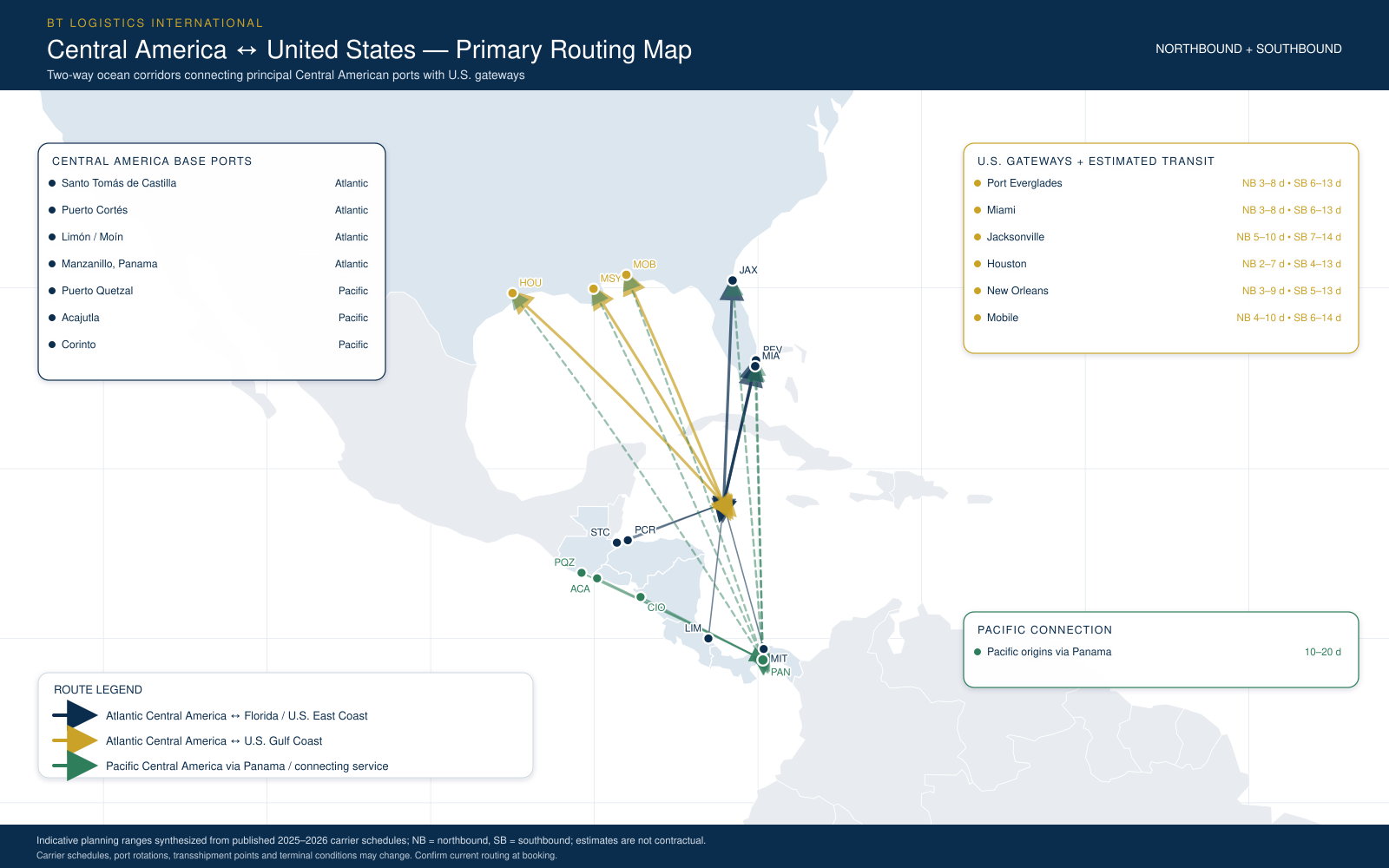
Indicative planning ranges are not contractual. Final routing, schedules, port rotations, transshipment points, and terminal conditions are confirmed for each booking.
ASIA
Trans-Pacific eastbound links from principal Asian origins.
BT supports freight from principal Asian markets to the United States and export planning in the opposite direction. Vessel schedules, equipment, transit time, and the selected U.S. gateway are reviewed for each shipment.
01
China
Shanghai, Ningbo-Zhoushan, Yantian/Shenzhen, Qingdao, and Xiamen
02
Singapore
Port of Singapore
03
Taiwan
Kaohsiung
04
South Korea
Busan
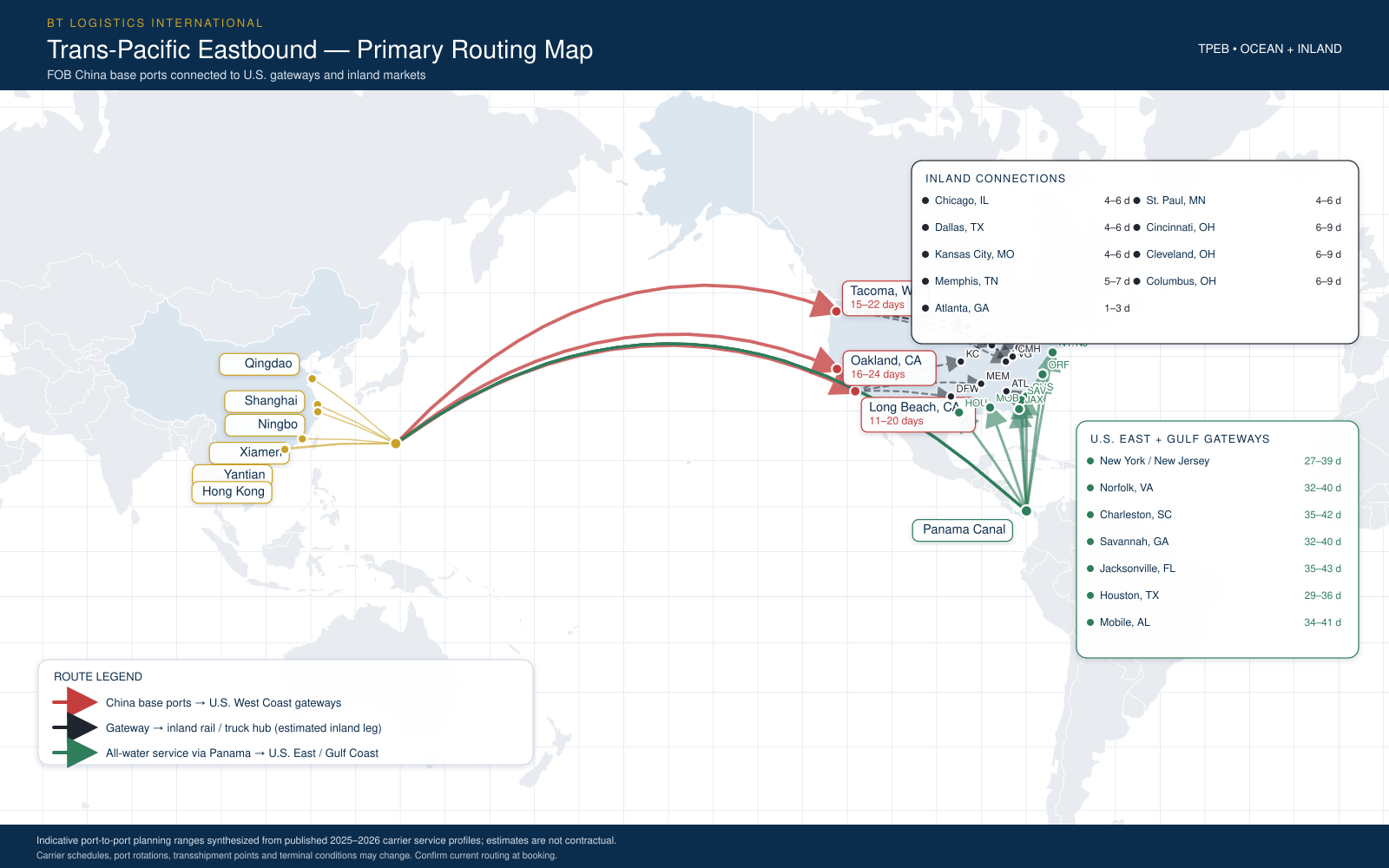
Indicative port-to-port and inland planning ranges are not contractual. Carrier schedules, port rotations, Panama Canal routings, and final inland connections are confirmed at booking.
EUROPE AND SOUTH AMERICA
European corridors and South American markets.
EUROPE
Northern and Mediterranean Europe
Northern Europe: Rotterdam, Antwerp-Bruges, Hamburg, and Bremerhaven.
Mediterranean Europe: Algeciras, Valencia, and Barcelona.
Import and export service is planned against cargo requirements, gateway options, and current carrier schedules.
SOUTH AMERICA
Brazil and Colombia
Coordination is available through major ports in Brazil and Colombia for cargo moving to or from the United States.
Shipment-specific planning accounts for origin, destination, service availability, documentation, and inland handoffs.
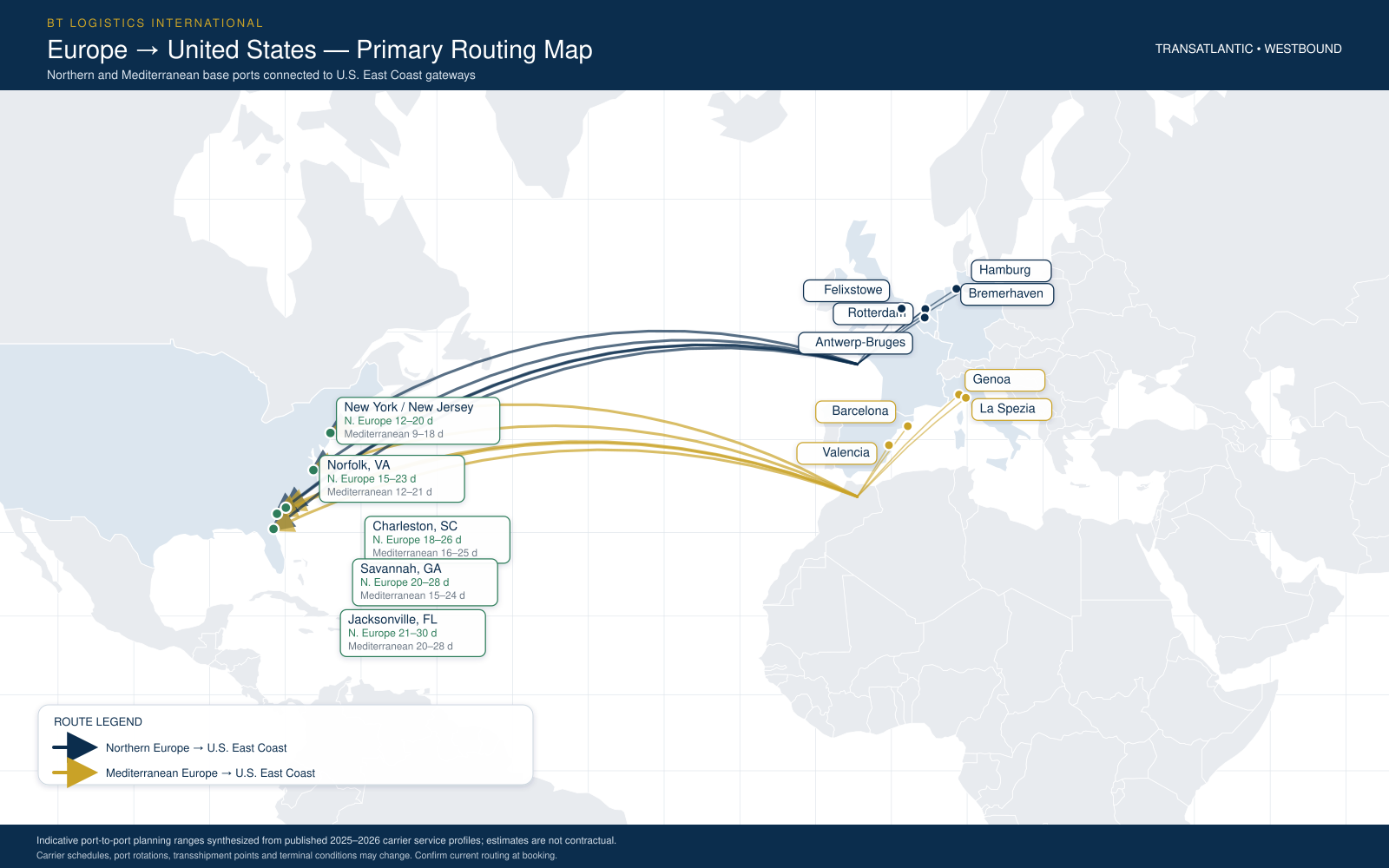
Indicative port-to-port planning ranges are not contractual. Carrier schedules, port rotations, transshipment points, and terminal conditions may change and are confirmed at booking.
PRINCIPAL U.S. GATEWAYS
Port options aligned with the international lane.
Gateway selection depends on carrier service, cargo profile, inland destination, equipment, and schedule. These principal ports support planning across the Atlantic, Pacific, Gulf, and South Atlantic coasts.
PACIFIC
West Coast
Los Angeles / Long Beach
Oakland
Seattle / Tacoma
ATLANTIC
East Coast
New York / New Jersey
Baltimore
Norfolk
Charleston
Savannah
SOUTH & GULF
South and Gulf
Miami / Port Everglades
Houston
New Orleans
Ports shown are principal planning gateways, not a promise of direct service. Final routing is confirmed against the shipment and current carrier schedules.
BOTH DIRECTIONS
Support for imports, exports, and the handoffs between them.
The direction changes the documentation, timing, responsibilities, and coordination points. BT starts by identifying what the shipment requires on each side of the route.
IMPORTING INTO THE UNITED STATES
Manage the international leg, information flow, arrival plan, licensed customs-broker handoff, and inland transportation as required.
EXPORTING FROM THE UNITED STATES
Arrange U.S. origin pickup, export routing, carrier or airline service, documentation flow, and destination-agent communication as required.
ROUTE PLANNING
The right lane depends on more than two locations.
Routing is reviewed around the shipment’s actual requirements and current service options—not a generic transit-time promise.
01
Cargo profile
Commodity, package count, dimensions, weight, equipment, and handling needs.
02
Timing
Cargo availability, required delivery window, schedules, and potential handoffs.
03
Documentation
Import or export direction, Incoterms, and information required by the licensed parties involved.
04
Final destination
Port or airport arrival, inland transportation, delivery access, and destination requirements.
50
States within BT’s coordination capability
Major U.S. ports, airports, rail ramps, and inland locations can be linked through ocean, air, drayage, rail, and regional transportation.
BEYOND THE INTERNATIONAL LEG
Keep the route connected before departure and after arrival.
BT can manage the U.S. side of the shipment, including origin pickup, port or airport transfer, regional transportation, and final delivery planning. When customs clearance is required, BT shares the needed information with appropriately licensed customs brokers.
LET’S REVIEW YOUR ROUTE
Tell us the origin and destination. We’ll help identify the next questions.
Share the cargo details, timing, and route you are considering so a logistics coordinator can review the available path.