
BT LOGISTICS • RESOURCES
Practical references for clearer shipping decisions.
Review practical guidance for Incoterms®, shipping documents, container equipment, and frequently asked questions—all in one place.
RESOURCE LIBRARY
Define the named place.
Confirm the rule, version, transport mode, and the exact point where delivery occurs.
EXPLORE THE GUIDES
Start with the reference your shipment needs.
01
Incoterms®
Understand delivery, cost, and risk responsibilities.
02
Shipping Documents
Get route-specific document guidance from BT.
03
Container Types
Compare common equipment and approximate dimensions.
04
FAQ
Review answers to common planning questions.
THE COMMERCIAL HANDOFF
What the selected rule helps define.
The eleven Incoterms® 2020 rules allocate delivery obligations, selected costs, and the point where risk passes from seller to buyer. They work best when the contract states a precise named place or port.
01
Delivery point
The location and condition in which the seller completes delivery under the chosen rule.
02
Cost allocation
Which party arranges or pays for carriage, loading, unloading, clearance, or insurance as the rule requires.
03
Risk transfer
The point at which loss or damage risk passes from seller to buyer—even when freight is paid farther ahead.
IMPORTANT LIMITS
The rule is not the entire sales contract.
Incoterms® rules do not determine price, payment terms, ownership transfer, product specifications, breach remedies, or the full customs and tax treatment. Those points remain in the sales contract and applicable law.
START WITH THE TRANSPORT MODE
Two families of rules.
Seven rules can be used with any mode or combination of modes. Four are reserved for sea and inland waterway transport when delivery is defined alongside or on board a vessel.
7 RULES
Any mode of transport
EXW, FCA, CPT, CIP, DAP, DPU, DDP
Suitable for road, rail, air, ocean, multimodal, and containerized movements when the named delivery point matches the transaction.
4 RULES
Sea and inland waterway only
FAS, FOB, CFR, CIF
Reserved for delivery alongside or on board a vessel at the named port. For containerized freight delivered to a terminal before loading, FCA may be more appropriate than FOB.
RULES FOR ANY MODE
Seven options for single-mode or multimodal shipments.
Compare the delivery point separately from the party paying the main carriage. Under CPT and CIP, for example, the seller pays to destination while risk passes earlier—when the goods are delivered to the first carrier.
EXW
Ex Works
Delivery and risk: When goods are placed at the buyer’s disposal at the named place, not loaded.
Transport: Buyer arranges the main carriage and usually export formalities.
FCA
Free Carrier
Delivery and risk: When the seller delivers to the buyer’s carrier at the named place.
Transport: Seller clears export; buyer arranges the main carriage.
CPT
Carriage Paid To
Delivery and risk: Risk transfers when goods reach the first carrier.
Transport: Seller pays carriage to the named destination; insurance is not required.
CIP
Carriage and Insurance Paid To
Delivery and risk: Risk transfers when goods reach the first carrier.
Transport: Seller pays carriage and the required higher-level cargo insurance to destination.
DAP
Delivered at Place
Delivery and risk: At the named destination, ready for unloading.
Transport: Seller carries to destination; buyer unloads and handles import clearance.
DPU
Delivered at Place Unloaded
Delivery and risk: After the seller unloads at the named destination.
Transport: Seller carries and unloads; buyer handles import clearance.
DDP
Delivered Duty Paid
Delivery and risk: At the named destination, ready for unloading.
Transport: Seller handles carriage, export and import clearance, duties, and taxes where legally possible.
SEA AND INLAND WATERWAY ONLY
Four port-to-port rules.
These rules use a named port of shipment or destination and depend on delivery alongside or on board the vessel. Cost and risk do not always transfer at the same point.
FAS
Free Alongside Ship
Delivery and risk: When goods are placed alongside the vessel at the named port of shipment.
Transport: Buyer arranges loading and the main ocean carriage.
FOB
Free On Board
Delivery and risk: When goods are on board the vessel at the named port of shipment.
Transport: Buyer arranges the main ocean carriage.
CFR
Cost and Freight
Delivery and risk: Risk transfers on board at origin.
Transport: Seller pays freight to the named destination port; insurance is not required.
CIF
Cost, Insurance and Freight
Delivery and risk: Risk transfers on board at origin.
Transport: Seller pays freight and minimum required insurance to the destination port.
CIP AND CIF
Both include insurance, but not at the same default level.
Under Incoterms® 2020, CIP normally requires broader cargo insurance than CIF. The parties can agree to different cover, but the contract should state that clearly.
BEFORE THE CONTRACT IS SIGNED
Write the rule so the delivery point is unmistakable.
A three-letter abbreviation alone is incomplete. Pair it with the exact named place or port and the edition of the rules.
FORMAT
Rule + named place + Incoterms® 2020
Example:
FCA Port of Baltimore, Maryland, USA, Incoterms® 2020
The named place should be precise enough to identify the intended delivery point.
CHECK
Five questions to resolve first.
- Where exactly should delivery occur?
- Who books and pays the main carriage?
- When should risk transfer?
- Who handles export and import clearance?
- Is cargo insurance required, and at what level?
Official source: The International Chamber of Commerce publishes and maintains the Incoterms® rules. Review the ICC Incoterms® 2020 overview or obtain the official publication for transaction-specific use.
This page is general information, not legal, customs, insurance, or tax advice.
DOCUMENT READINESS
Required Shipping Documents
Document requirements vary by origin, destination, commodity, transport mode, and customs profile. BT Logistics will confirm the applicable checklist for each shipment rather than publish a generic list that may not fit your cargo.
FOR AN ACCURATE CHECKLIST
Start with the shipment profile.
Share the cargo description, origin, destination, transport mode, direction, and required timeline. Our team can then identify the documents that apply to the route and cargo.
EQUIPMENT REFERENCE
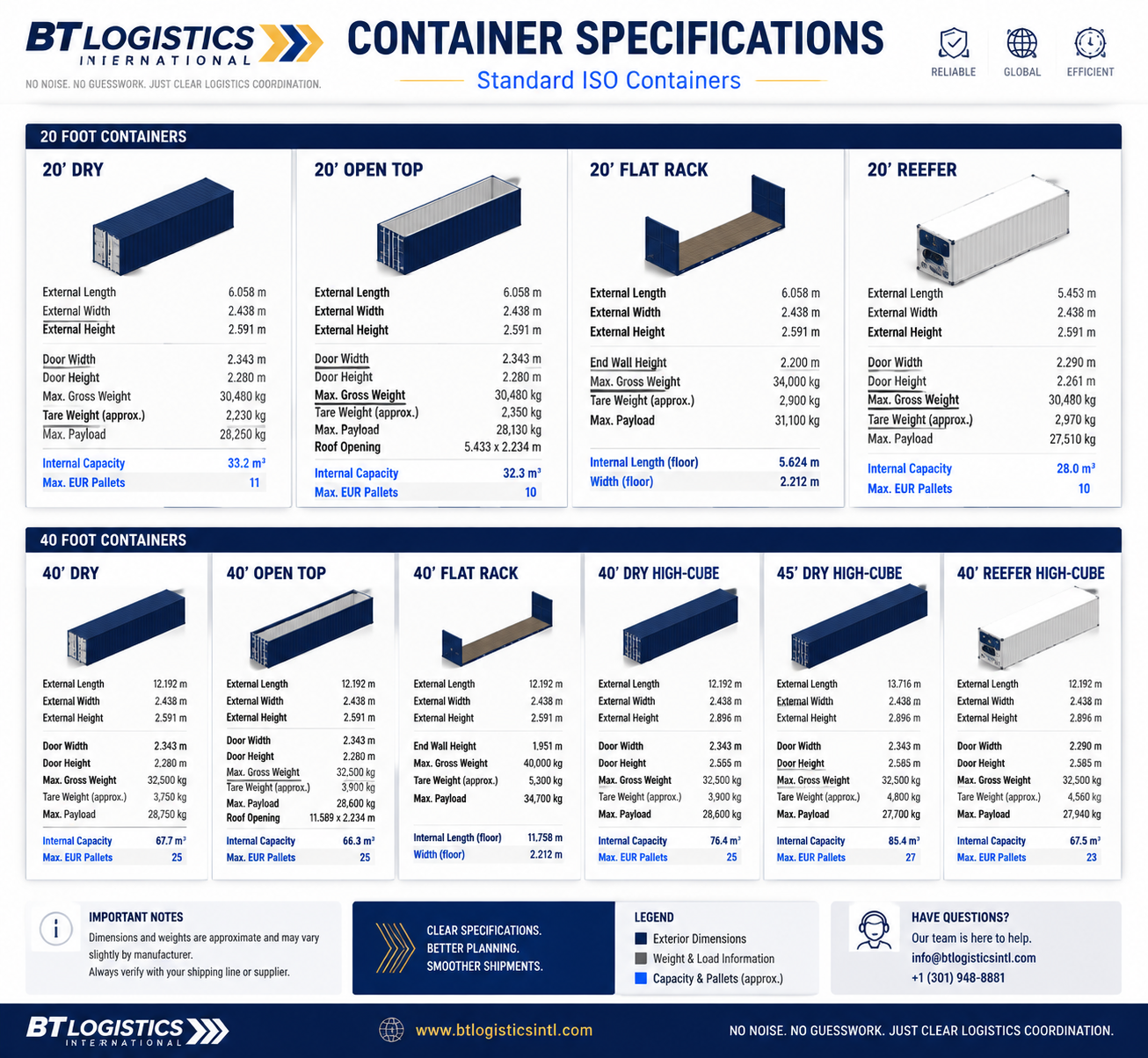
Container Types & Dimensions
Use this chart as an initial reference for common dry, open-top, flat-rack, high-cube, and reefer equipment. Final availability, dimensions, payload, and carrier acceptance must be confirmed before booking.
IMPORTANT PLANNING NOTE
Dimensions and weights are approximate and may vary by manufacturer, equipment series, and carrier. For the 20′ reefer, confirm the equipment drawing with the shipping line: 5.453 m is commonly listed as an internal length, while the external length is approximately 6.058 m.
COMMON QUESTIONS
What customers ask before the first move.
These answers cover the most common questions. Shipment-specific requirements are reviewed route by route.
01
Are you a freight forwarder or a carrier?
BT Logistics International is a freight forwarder and FMC-licensed NVOCC. We coordinate transportation with ocean carriers, airlines, truckers, customs brokers, warehouses, and overseas agents.
02
Do you handle both imports and exports?
Yes. We coordinate imports into the United States and exports from the United States across key international trade lanes.
03
Can you handle both full containers and smaller shipments?
Yes. We coordinate both FCL and LCL ocean freight, depending on the cargo volume, route, and customer requirements.
04
Do you provide customs clearance?
We coordinate with licensed customs brokers and assist with the flow of shipment information and documents. Customs brokerage is performed by the appropriately licensed party.
05
Can you coordinate transportation anywhere in the United States?
Yes. We can coordinate inland, air, and ocean transportation to and from locations throughout all 50 states.
06
What information is needed for a quote?
Origin, destination, commodity, dimensions, weight, package count, cargo availability date, Incoterms when applicable, and any special handling requirements.
READY TO PLAN YOUR SHIPMENT?
Include the selected rule and named place with your cargo details.
BT can review the routing details needed for a freight quote. The commercial parties remain responsible for agreeing on the Incoterms® rule in their sales contract.